Agentic AI Needs Operational Guardrails: From ReAct Loops to Production Controls

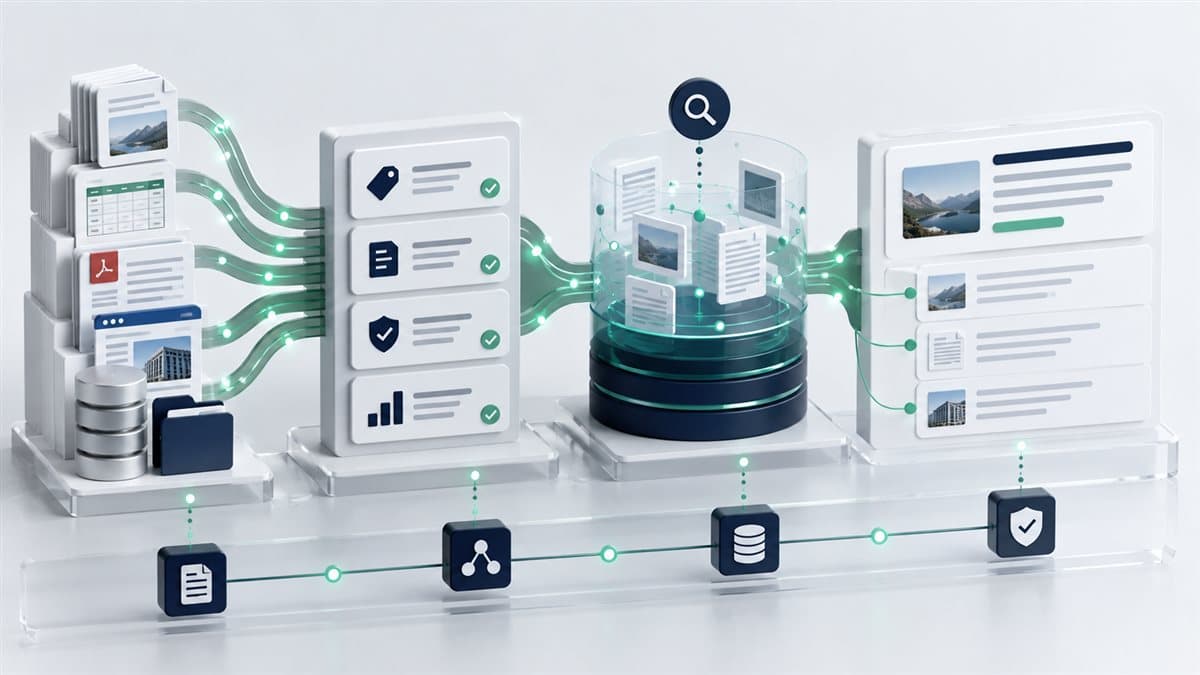
Figure: Conceptual overview of the platform.
Agentic AI is best understood as a system pattern, not a claim of autonomy. A model can reason over a goal, call tools, inspect the resulting state, and decide what to do next. The ReAct research pattern made this interaction between reasoning and action explicit; production systems add a harder concern: every tool call can change data, trigger a workflow, or expose sensitive context.
The engineering question is not whether an agent can complete a demo. It is what the agent is authorized to do, what evidence it must use, how its decisions are recorded, and how the system behaves when tools fail or confidence is low.
Bound the authority, not only the prompt
A prompt can describe rules, but it should not be the only enforcement layer. Tool permissions belong in the system design: allow-listed operations, scoped credentials, validated inputs, idempotency keys for state changes, rate limits, and a separate approval boundary for irreversible actions.
For example, an agent may be allowed to draft a support response, retrieve approved documentation, and create a proposed ticket. Sending an external message, modifying a production record, or issuing a payment should require a deliberately designed approval step. This keeps capability proportional to the risk of the action.
- Read-only retrieval tools by default; narrowly scoped write tools only where the workflow demands them.
- Schema-validated tool inputs and server-side authorization independent of model output.
- Idempotent, auditable commands for any action that changes state.
- Human approval for high-impact, irreversible, or externally visible actions.
Treat execution traces as operational data
An agent run should produce a trace that a reviewer can understand without reconstructing the conversation from memory: task identifier, model and prompt version, tools offered, tool inputs and outputs with sensitive values protected, retrieved evidence, approval events, retries, final result, and failure reason.
Those traces enable incident review, cost analysis, regression testing, and improvement of the workflow. They also create a practical bridge between AI engineering and established platform practices such as observability, access control, deployment controls, and change management.
When an agent relies on enterprise knowledge, the retrieved evidence needs the same ownership, freshness, and traceability described in RAG Is a Data Product, Not a Prompt.
Roll out agentic AI as a controlled capability
Production rollout should begin with a narrow workflow that has a clear owner, bounded tools, and measurable outcomes. Shadow mode is useful when the agent can propose an action while a human or deterministic system remains responsible for the final decision. It exposes tool-selection mistakes, missing knowledge, and unsafe assumptions without expanding operational risk.
Promotion criteria should be explicit: stable task success on a reviewed evaluation set, no unresolved policy violations, acceptable latency and cost, and an operator who can pause or roll back the workflow. This is standard release discipline applied to agentic AI, not a separate experimental process.
Evaluate the workflow, not just the final wording
A useful evaluation suite includes representative tasks, adversarial inputs, unavailable tools, ambiguous requests, stale data, and permission-denied conditions. Pass criteria should include policy compliance and safe failure, not merely task completion. A system that occasionally completes the right task by taking an unauthorized action is not production-ready.
This is why agentic AI is a platform concern. The durable advantage comes from a reliable execution environment around the model: controlled tools, trusted data, measurable behavior, and a clear owner for the outcome.