Designing Data Platforms for Regulated Industries: Lessons from Finance & Insurance

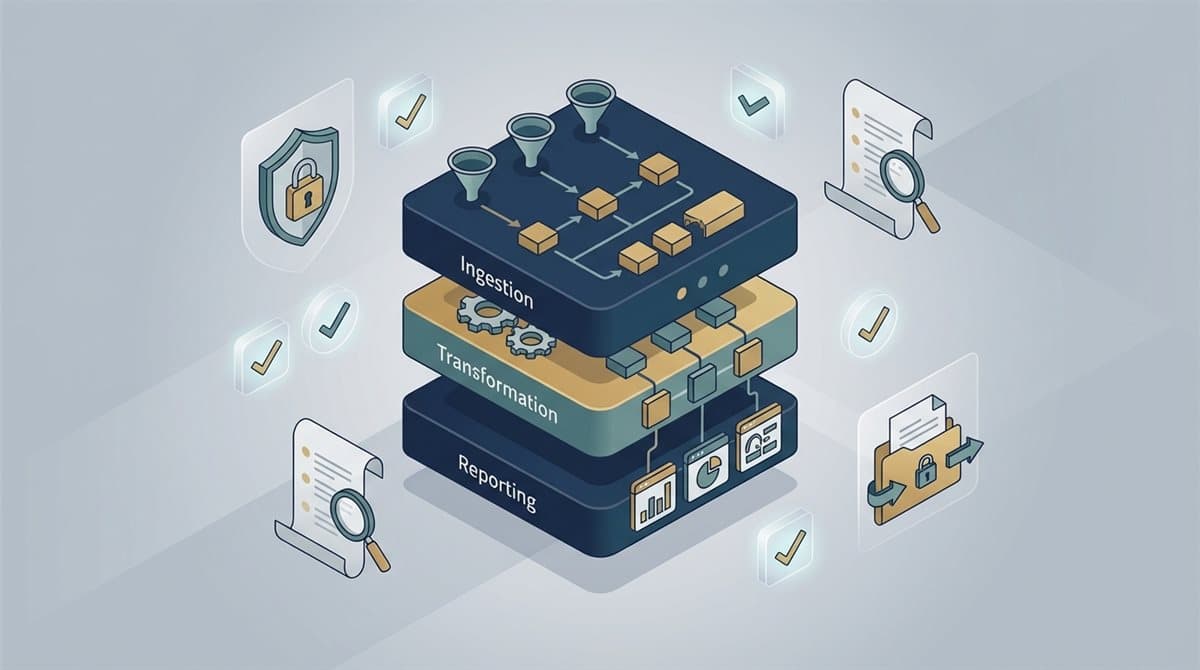
Figure: Conceptual overview of the platform.
Designing data platforms in regulated industries changes the architectural conversation from the beginning. In finance and insurance, scalability or modularity alone is not enough; what defines success is traceability, defensibility, and operational resilience under regulatory scrutiny.
Architecture becomes a structural commitment: every decision must assume it could be audited or questioned years later, reshaping ingestion layers, transformation logic, and reporting systems.
Compliance as an Architectural Constraint
Compliance must be embedded into the platform rather than layered on top. When lineage, retention rules, and access control are designed from inception, they become structural properties instead of perceived friction.
Immutable raw zones, version-controlled transformations, and documented business logic become defensive strategies that reduce operational stress when audits arrive.
Lineage, Transparency, and Reproducibility
Financial reporting and insurance risk models must explain how numbers were produced. Metadata management becomes an architectural core, not a secondary concern.
Lineage guarantees traceability to the origin, reproducibility ensures consistent outcomes, and controlled schema evolution prevents silent breaks in historical assumptions. These capabilities must be designed upfront, not improvised under pressure.
Separation of Concerns as Defensive Architecture
Layered architecture is more than aesthetic clarity. Clear separation between raw ingestion, standardized transformation, and curated serving layers prevents accidental corruption of historical data and lets auditors inspect systems in logical stages.
Boundaries reduce ambiguity, create checkpoints, and let the platform evolve internally without compromising external accountability. Without them, compliance is fragile.
Governance and Change Management
Governance is the mechanism that enables safe innovation. Schema changes, transformation updates, and infrastructure modifications must follow documented processes with review gates and impact assessments.
Data contracts and ownership definitions ensure rapid changes do not propagate unintended consequences across interconnected reporting systems. Governance pursues controlled evolution, not restriction.
That shift from implementation toward architectural guardrails and long-term accountability is explored further in From Data Engineer to Platform Owner.
Security by Design
Finance and insurance datasets contain highly sensitive information. Role-based access control must be granular, encryption must be standard, and audit logging must capture meaningful access patterns.
Security cannot be retrofitted once the platform distributes; designing with security from the start prevents long-term instability.
Operational Resilience Under Scrutiny
Downtime in regulated environments is not merely inconvenient; it can trigger regulatory exposure. Backup strategies, failover systems, and monitoring frameworks must operate with predictable stability.
Resilience is measured by consistency under stress as much as by recovery time.
Balancing Control and Agility
Regulation does not have to restrict agility. Modular architecture allows controlled experimentation by isolating sandbox environments from governed production layers.
Clear contracts and governance frameworks let teams iterate safely while maintaining oversight-turning compliance into an architectural strength instead of a burden.
Lessons for Platform Architects
Regulated ecosystems reinforce universal principles: design for auditability from inception, treat metadata as infrastructure, define ownership clearly across domains, and align platform evolution with regulatory timelines rather than reacting to them.
These lessons strengthen any large-scale data platform, regulated or not.
Conclusion
Designing data platforms for regulated industries demands architectural discipline and long-term thinking. Balancing scalability with transparency and innovation with accountability turns reliability and compliance into core dimensions of engineering excellence.